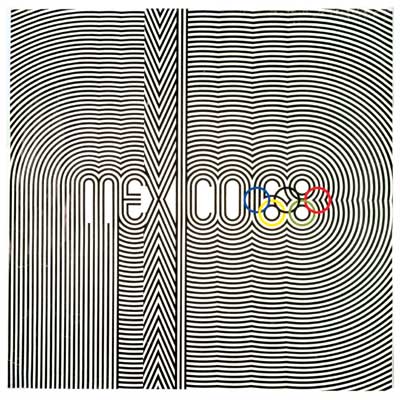
The 1968 Olympics poster used line in pattern and repetition to create a striking visual. The lines are all the same weight and distance apart and the repetition makes it seem like it's vibrating. The poster is simple in essence but looks more complicated in the use of repetition.
A number of other posters were created and designed by New York Designer Lance Wyman. he used the 60's Op-Art Typography that set the tone for all the other various posters.
they are very different in the way 1968 is very balanced and bolder in colour, the london logo is a jumble of shapes and colours and is dynamic with all straight lines as opposed to all curved lines of Mexico's logo.
The eagles poster is dynamic in the way the eagle is flying diagonally through the image. the only colours used are the team colours and they are effective in creating hierarchy in the strength of the typography for example the black is stronger than the blue. The black also allows the detail to be more visible for example in the feathers. the word 2006 Premiers are made very visible in bold uppercase and black colour.
art made by combining a collection of three‑dimensional objects into a whole. It can either be a free‑standing sculpture or be mounted on a panel, and it is usually made from scraps, junk, or various manufactured or natural objects.
Aesthetic
pertaining to the artistic and beautiful; a perception that something pleases the eye.
Motif
element or
combination of elements repeated often enough in a composition to become a
dominant feature.
Atmospheric perspective way of showing depth and distance in a painting by
using fading colors and hazy details to indicate objects in the distance. Fresco paintingdone with water‑based paint on fresh
plaster so that as it dries the colors are absorbed into the wall.
Adjectives
Abstract
Artwork in which the subject matter is stated in a brief, simplified manner; little or no attempt is made to represent images realistically, and objects are often simplified or distorted. eclectic
Selecting or employing individual elements from a variety of sources, systems, or styles: an eclectic taste in music; an eclectic approach to managing the economy.
Made up of or combining elements from a variety of sources: “a popular bar patronized by an eclectic collection of artists, writers, secretaries and aging soldiers on reserve duty” (Curtis Wilkie).
Gothic architectural style developed in western Europe
from the 1100s to the 1400s, characterized by pointed arches, tall buildings
with thin walls and large stained glass windows, and airy interior space.
LINE
Line can be considered in two ways. The linear marks made with a pen or brush or the edge created when two shapes meet.
SHAPE
A shape is a self contained defined area of geometric or organic form. A positive shape in a painting automatically creates a negative shape.
DIRECTION
All lines have direction - Horizontal, Vertical or Oblique. Horizontal suggests calmness, stability and tranquillity. Vertical gives a feeling of balance, formality and alertness. Oblique suggests movement and action
SIZE
Size is simply the relationship of the area occupied by one shape to that of another.
TEXTURE
Texture is the surface quality of a shape - rough, smooth, soft hard glossy etc. Texture can be physical (tactile) or visual.
Elements:
BALANCE
Balance in design is similar to balance in physics
A large shape close to the center can be balanced
by a small shape close to the edge. A large light
toned shape will be balanced by a small dark toned
shape (the darker the shape the heavier it appears to be)
GRADATION
Gradation of size and direction produce linear perspective. Gradation of of colour from warm to cool and tone from dark to light produce aerial perspective. Gradation can add interest and movement to a shape. A gradation from dark to light will cause the eye to move along a shape.
REPETITION
Repetition with variation is interesting, without variation repetition can become monotonous. The five squares above are all the same. They can be taken in and understood with a single glance. When variation is introduced, the five squares, although similar, are much more interesting to look at. They can no longer be absorbed properly with a single glance. The individual character of each square needs to be considered. If you wish to create interest, any repeating element should include a degree of variation.
CONTRAST
Contrast is the juxtaposition of opposing elements eg. opposite colours on the colour wheel - red / green, blue / orange etc. Contrast in tone or value - light / dark. Contrast in direction - horizontal / vertical.
The major contrast in a painting should be located at the center of interest. Too much contrast scattered throughout a painting can destroy unity and make a work difficult to look at. Unless a feeling of chaos and confusion are what you are seeking, it is a good idea to carefully consider where to place your areas of maximum contrast.
HARMONY
Harmony in painting is the visually satisfying effect of combining similar, related elements. eg.adjacent colours on the colour wheel, similar shapes etc.
Conceptual art is an artists interpretation of a concept usually for moving image movies for example. The concept(s) or idea(s) involved may be constructed by anyone simply by following a set of written instructions. conceptual artists include Joseph Kosuth, Lawrence Weiner
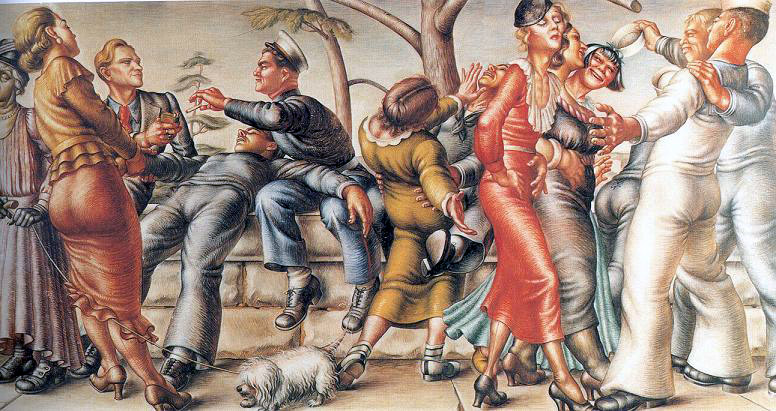
Magic realism or magical realism is an aesthetic style or genre of fiction in which magical elements blend with the real world. Magic realism a term used by American painters such as Ivan Albright, Paul Cadmus, George Tooker and other artists during the 1940s and 1950s.
Cubism is a 20th century art movement, pioneered by Pablo Picasso and Georges Braque. In cubist artworks, objects are broken up, analyzed, and re-assembled in an abstracted form—instead of depicting objects from one viewpoint, the artist depicts the subject from a multitude of viewpoints.
Suprematism was an art movement focused on fundamental geometric shapes like squares and circles. It started in Russia in 1915-1916. It was founded by Kasimir Malevich. Artists include Aleksandra Ekster, Olga Rozanova, Nadezhda Udaltsova, Ivan Kliun, Liubov Popova.
Futurism was an artistic and social movement that originated in Italy in the early 20th century. It emphasized and glorified themes associated with contemporary concepts of the future, including speed, technology, youth and violence, and objects such as the car, the airplane and the industrial city. Key figures of the movement include the Italians Filippo Tommaso Marinetti, Umberto Boccioni, Carlo Carrà, Gino Severini, Giacomo Balla, Antonio Sant'Elia, Tullio Crali and Luigi Russolo.